
Modern enterprises and government agencies now rely on more non-human identities than ever before. APIs, bots, CI/CD pipelines, microservices, IoT, RPA, and every service account behind the scenes are making critical decisions and touching sensitive data at machine speed. As a result, non-human identity management is no longer a niche capability, it’s a core pillar of identity security and Zero Trust.
Non-Human Identities
Non-human identities are credentials, keys, certificates, tokens, and service principals used by software and infrastructure to authenticate and authorize actions. Unlike human identities, they don’t sit at a desk, but they often hold elevated privileges and persistent access to sensitive data. As organizations scale microservices and cloud-native architectures, non-human identities routinely outnumber human identities by 144:1 or more.
The core security challenge: non-human identities tend to be created ad hoc, shared informally, and rarely rotated: an ideal recipe for unauthorized access and drift in your security posture. Treating them as first-class citizens in your program is essential.

What is Non-Human Identity Management?
Non-human identity management is the practice of governing machine identities, secrets, certificates, and service account credentials with policies and controls that are auditable and enforceable. It brings discipline to how digital identities are provisioned, used, and deprovisioned, with full visibility for security teams. Done right, it reduces security risk without adding friction to delivery teams.
How to Manage Non-Human Identities
To effectively manage non-human identities, establish clear ownership, standardize how they’re requested, issued, rotated, and retired, and enforce policy with automation. Start by building an inventory to gain visibility into where NHIs exist (cloud accounts, Kubernetes, build pipelines, enterprise apps, data platforms), then map each to a business purpose and lifecycle owner.
Key Capabilities of NHI Management:
- Inventory and classification for all non-human entities and NHIs
- Least-privilege policies aligned to roles, environments, and data sensitivity
- Automated credential rotation and certificate renewal
- Event-driven deprovisioning when workloads or services change
- Centralized logging, attestation, and continuous anomaly detection
- Short-lived tokens and certificates by default
- Policy as code to enforce standards consistently across environments
Identity Security for NHIs

Identity security for NHIs must be policy-driven, API-first, and integrated into the same control plane as your human identities. Achieve this by aligning NHI controls with Zero Trust principles: never trust, always verify; assume breach; and verify every request with context. This strengthens your overall security posture and limits blast radius.
Machine Identities vs Human Identities
While human identities require user-centric experiences (MFA, SSO, adaptive access), machine identities emphasize cryptographic trust, short-lived credentials, and workload-to-workload authorization. Both require governance, but machine identities demand greater automation and precision because they operate at high frequency and scale. Your program should unify policies for human and non-human identities to avoid blind spots.
Service Account Lifecycle
Service account sprawl is a common root cause of incidents. Treat every service account like any other identity:
- Request and approval: require business justification and owner
- Provisioning: assign minimal permissions and environment scope
- Rotation: automate key and password changes at defined intervals
- Review: schedule access recertifications
- Deprovisioning: remove promptly at workload retirement
This lifecycle approach reduces security risk and improves audit readiness.
Access Management for NHIs
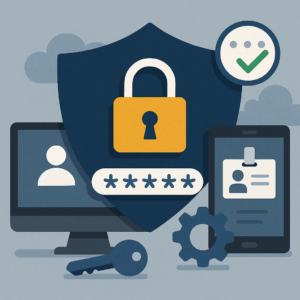
Access management for NHIs should combine strong authentication (mutual TLS, OIDC for workloads, workload identity federation) with fine-grained authorization (ABAC/RBAC aligned to environment and data classification). Integrate these controls into CI/CD so you can automate enforcement from build to production.
Visibility for Digital Identities
You can’t manage what you can’t see. Build centralized visibility across all digital identities, human users and NHIs, spanning cloud providers, directories, secrets managers, and service meshes. Prioritize dashboards that show:
- Where machine identities exist and what they can access
- Which service account permissions are unused or excessive
- Credential age, rotation status, and certificate expirations
- Anomalous access patterns that may indicate compromise
Identity and Access Management in Practice

A unified identity and access management program stitches together policy, provisioning, and monitoring for both human and non-human identities. Standardize request flows, approvals, provisioning templates, and revocation logic. Centralize policy while empowering teams to automate safely. This reduces complexity and accelerates audits.
Lifecycle Management and Automation
Lifecycle controls are most effective when you automate them end-to-end. Embed guardrails in pipelines so that:
- New workloads automatically receive scoped identities
- Credentials are rotated on release or on a schedule
- Decommissioned services trigger revocation
- Drift is detected and corrected continuously
This degree of automation drives speed and consistency while shrinking windows for unauthorized access.
Non-Human Identity (NHI) Security and Management

Strong NHI security depends on measurable controls. Establish KPIs such as:
- Percentage of non-human identities under governance
- Time-to-rotate credentials and certificates
- Reduction in standing privileges for service account roles
- Coverage of machine identities across environments
Reporting these outcomes demonstrates program maturity and builds leadership confidence.
Identity Threat Scenarios to Watch
Common identity threat patterns involving non-human identities include:
- Leaked secrets in repositories or build logs
- Overprivileged service account roles exploited post-breach
- Stale machine identities left active after workload retirement
- Long-lived certificates enabling lateral movement
Mitigate these by tightening policies, increasing visibility, and using automation to enforce the lifecycle. By design, this improves your security posture across the board.
FAQ: Non-Human Identity Security
What are the first three steps to bring non-human identities under control?
Inventory and classify all non-human entities across cloud, platforms, and pipelines.
Assign ownership and define a standard lifecycle for each service account and certificate.
Automate rotation and revocation using policy as code integrated with CI/CD.
How do we reduce unauthorized access without slowing delivery teams?
Adopt least privilege with short-lived credentials, enforce workload identity federation, and automate issuance/rotation in pipelines. This removes manual steps and decreases security risk.
What metrics prove our NHI management program is working?
Track governance coverage of NHIs, credential age and rotation rates, reduction in unused permissions, and time-to-revoke when services are decommissioned. Improved visibility and faster lifecycle actions directly reduce risk and quantify NHI management efforts.
How do machine identities fit into Zero Trust?
They are central to Zero Trust: every call is authenticated and authorized with context. By unifying identity and access policies for human users, and machine identities, you minimize blind spots and strengthen defense-in-depth.
Do we need separate tooling for human and non-human identities?
Not necessarily. Many organizations succeed with a unified control plane that handles identity security and lifecycle for both human and non-human identities, while using specialized components where needed.
Make Non-Human Identity Management a Business Advantage

Non-human identities now power your critical services, and attackers know it. Treat them like the first-class digital identities they are: assign owners, enforce least privilege, standardize lifecycle controls, and automate everything you can. The payoff is clear: reduced security risk, fewer gaps that enable unauthorized access, and a stronger, measurable security posture.
UberEther’s IAM Advantage gives you a FedRAMP High and DoD IL5-ready identity foundation that unifies governance for human and non-human identities, with the automation and visibility your security teams need to move fast and stay compliant. If you’re ready to operationalize NHI security at scale, get in touch with UberEther today to see how we can help.